
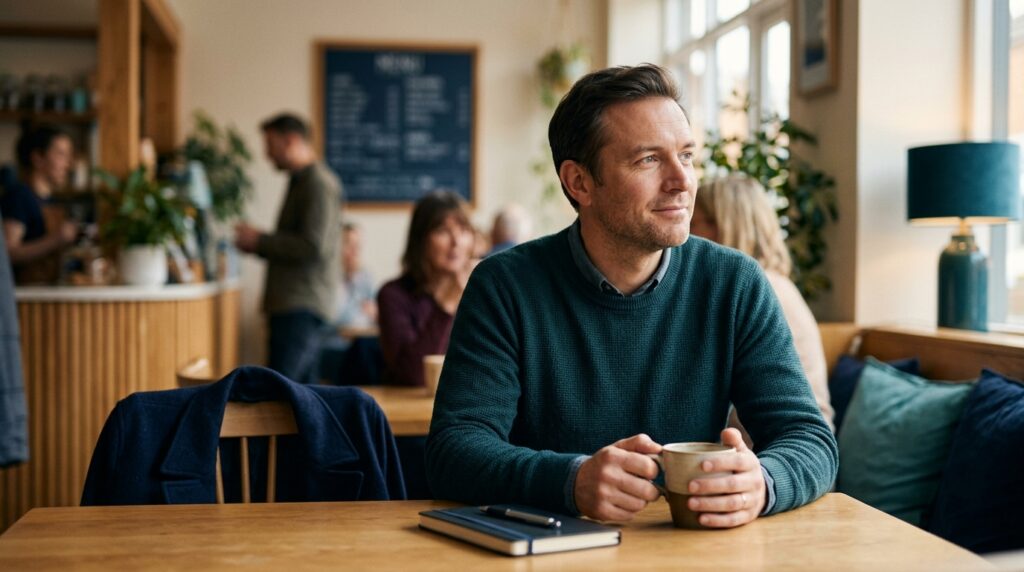
Here's an uncomfortable truth about dating profiles: nobody reads your bio properly until after they've already decided, in about one and a half seconds, whether they fancy the look of you. Your photos aren't just illustrations for your personality. They are, for better or worse, the first and loudest thing you say about yourself. And most people have absolutely no idea what they're actually saying.
This isn't about being conventionally attractive. It's about accidental messaging. You might think that mirror selfie in the gym is showing off a nice physique. What it might actually be saying is "I spend more time with dumbbells than with other humans, and I'm not entirely sure how a camera works." You might think the sunglasses photo looks mysterious and cool. What it's actually saying is "I am hiding my eyes from you, possibly because I am a wanted criminal, possibly because I just don't want you to really see me."
Let's go through what your photos are actually telling people, often entirely by accident, and what you might want to do about it.
Key takeaways
- Every photo you choose sends a message, whether intentional or not: context, body language and setting all get read as information.
- Sunglasses, heavy filters and group shots that hide which person is you tend to read as evasive, even when that's not the intention.
- Recent, varied, well-lit photos that actually show your face and a bit of your life are far more effective than one heavily edited hero shot.
- Photos with your kids, ex-partners cropped awkwardly out, or obvious soon-to-be-deleted gym selfies all send specific, usually unhelpful, signals.
- Honesty in photos saves everyone time: it attracts people who like the real you and filters out those who were only ever going to be disappointed on arrival.
The sunglasses and the hat: what you're hiding and why it matters
Let's start with the classics. Sunglasses in every single photo. A cap pulled down low. A face partially obscured by a strategically angled phone. On the surface, these all feel like perfectly reasonable choices. Maybe you think you look better in sunglasses. Maybe it was just sunny that day. Fair enough.
But here's what the other person sees: a profile where they genuinely cannot picture your face. And dating, whatever else it is, runs substantially on the ability to picture someone's face. If every photo hides your eyes, people quite reasonably start wondering what else you might be hiding. Not because you're necessarily hiding anything, but because our brains are pattern-matching machines and this pattern reads as evasive.
The fix isn't complicated: have at least a couple of photos where your actual, unobscured, slightly imperfect face is clearly visible. You don't need a professional headshot. You need a human being looking at a camera without an accessory in the way.
The group photo where nobody knows which one is you
We've all done it. The photo from your mate's birthday where you look genuinely happy, surrounded by five other people, and somehow it ends up as your profile's lead photo. The trouble is that whoever's looking at your profile now has to play a slightly awkward guessing game. Is it the person on the left? The one laughing in the middle? The person who's accidentally got their eyes closed?
This isn't really about vanity. It's about basic clarity. Nobody wants to message someone and then discover, upon meeting, that they'd actually been admiring your best friend's jawline for three weeks. Group photos are lovely as a secondary image, showing you have a social life and actual friends who tolerate you. As your main photo, they're just confusing.
If you do include group shots, which can be genuinely useful for showing you're a normal, sociable person, make sure your other photos clearly establish which face is yours first.
The heavily filtered glow-up versus the person who turns up
Filters that smooth skin, slim faces, enlarge eyes or otherwise edit you into a slightly different person are an interesting case, because the intention is usually innocent. You just want to look your best. Nobody's crime scene here.
Except it does create a problem, and it's not really a moral one, it's a practical one: the person meeting you in real life is going to meet you, not your filtered avatar, and that gap between online photo and actual human being creates an awkward moment on a first date that nobody enjoys. Watching someone's face do a tiny recalibration as they realise you look different from your photos is not a great start to an evening.
A good general rule is to ask: would someone recognise me from this photo if they walked past me on the street? If the honest answer is "probably not", it's worth swapping for something closer to how you actually look on an average Tuesday.
The decade-old photo nobody mentioned was from a decade ago
Using an old photo because it's objectively a brilliant photo of you is tempting and completely understandable. The trouble is that time keeps happening to all of us, rudely and without permission, and a photo from eight years ago represents a version of you that no longer quite exists.
This isn't really about age so much as honesty. Using outdated photos sends the accidental message that you're either unaware of how you currently look, or aware and deliberately managing the gap. Neither is a great foundation for a first date. Recent photos, even if you feel less thrilled with how you currently look than you did a decade ago, build trust before you've even said hello.
A simple habit: if you can't remember roughly when a photo was taken, it's probably too old to use.
Kids, exes and the mysteriously cropped-out arm
Photos featuring your children are a genuinely tricky area. Plenty of people want to be upfront about being a parent, which is entirely reasonable, but showing your kids' faces on a public dating profile raises real privacy and safety considerations worth thinking through carefully. A mention in your profile text, or a photo that doesn't clearly show their faces, generally does the job without putting your children on display to strangers.
Then there's the classic cropped-out ex. You know the one. A lovely holiday photo, clearly taken by or with somebody else, where there's a conspicuous arm around your waist that belongs to nobody currently in frame. It's usually obvious, and it tends to raise more questions than the photo was worth. If a picture needs surgery to be dating-profile appropriate, it's generally easier to just pick a different picture.
None of this requires forensic honesty about your entire romantic history. It just means choosing photos that don't quietly broadcast things you'd rather not explain in a first message.
What actually works, without pretending to be someone else
The good news is that none of this requires professional photography, expensive styling or pretending to have hobbies you don't have. A handful of simple things make a real difference: decent natural light (a window beats a dim pub every time), a recent photo where your whole face is visible, one photo that shows a bit of your actual life (walking the dog, out with friends, doing the thing you genuinely enjoy on weekends) and photos that are honestly, recognisably you.
Variety helps too. One photo tells people what you look like. Several photos, taken at different times in different contexts, tell people what you're actually like. That's a much more useful thing to communicate, and it tends to attract people who like the real version of you rather than a carefully constructed highlight reel.
The underlying point, really, is that photos are a form of communication, just like a message or a conversation. Treating them with the same honesty you'd want to apply to the rest of your profile tends to save everyone a fair bit of time and a fair bit of awkwardness on the night itself.
Frequently asked questions
How many photos should I use on my dating profile?
There's no magic number, but somewhere between four and six tends to work well: enough to show your face clearly from different angles and contexts, without turning your profile into a full photographic retrospective. Quality and honesty matter far more than quantity.
Is it okay to use a filtered photo at all?
Light editing, like adjusting brightness, isn't the issue. The problem is filters that meaningfully change your face shape, skin or features, because they create a gap between your photo and the person who actually turns up. If in doubt, ask whether a friend would recognise you instantly from the photo.
Should I include photos with my children on a dating profile?
Many people choose not to show their children's faces publicly for privacy and safety reasons, even if they're open about being a parent. Mentioning it in your profile text, or using a photo where their faces aren't identifiable, is a common and sensible approach.
What's wrong with using sunglasses in most of my photos?
Nothing wrong with the occasional sunglasses photo, but if every single image hides your eyes, it tends to read as evasive, even when that's not your intention at all. Including a couple of clear, unobscured photos helps people feel like they actually know who they're talking to.